
Building Custom Agent Harnesses for Specific Domains Using Vercel's AI SDK
What is an agent harness?
An agent harness is the software around an AI model that lets it work on a task. It supplies context and tools, executes the model's tool requests, feeds back the results, and controls when the agent continues or stops.
For example, the model requests an order lookup. The harness returns the order, giving the model the information it needs to check inventory or ask a follow-up question.
HumanLayer describes a coding agent's harness as “the agent’s runtime” in Kyle's Skill Issue: Harness Engineering for Coding Agents. Cloudflare's documentation describes the work around each model turn, including prompt construction, tool handling, message persistence, and stopping decisions.
| Agent | Context it needs | Tools it can use | Application controls |
|---|---|---|---|
| Coding assistant | Repository files, instructions, previous work | Read files, edit code, run tests | File access, command permissions, execution limits |
| Damaged-order support assistant | Selected order, damage report, policy, saved decisions | Look up an order, check stock, propose a replacement | Case ownership, replacement eligibility, approval |
We'll build the support example with Next.js, Vercel's AI SDK, AI Elements, and PostgreSQL, then compare Sol and Luna on the same conversations. The walkthrough assumes familiarity with TypeScript and web applications.
An agent harness runs the agent. An eval harness runs test conversations against it and checks the results. The example repository includes both.
The job: replace one broken mug
Parcel & Pine is a fictional homewares store. A support employee opens a case for Alex Morgan, whose order contained two mugs. One arrived broken.
The employee types:
Let's replace it for them.
The assistant should use the open case to check the order, policy, and stock, then save a proposal for one replacement. The employee reviews that proposal and clicks Approve. Afterward, “Let the customer know” should produce a customer reply draft based on the recorded decision.
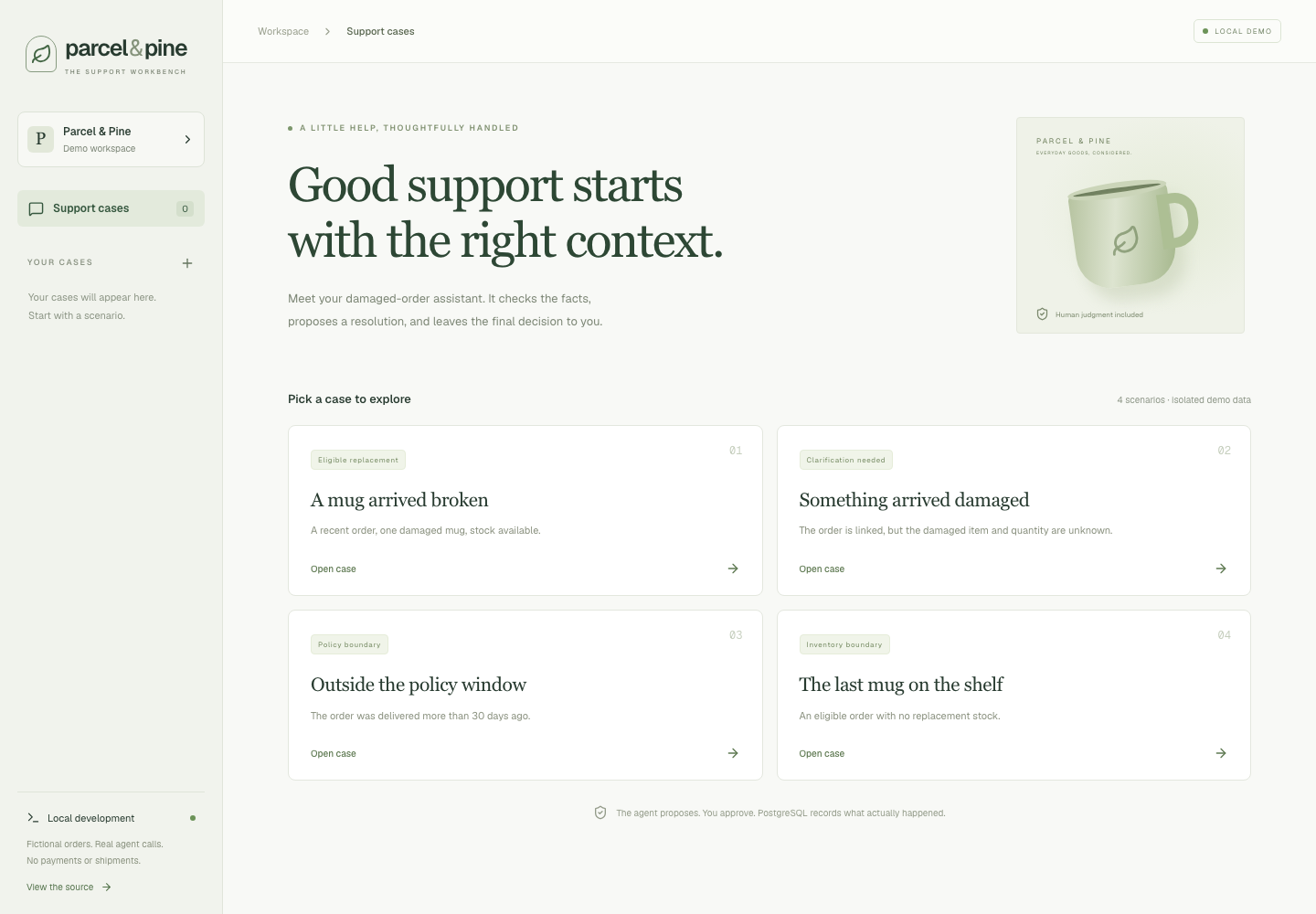
The local workbench uses fictional orders. Each case has independent stock and conversation history.
The store policy requires a damage report within 30 days of delivery, enough stock, and a replacement quantity within the purchased quantity. The scenarios use a fixed reference date so an eligible example does not expire between publication and the day someone runs it.
Approval creates a simulated replacement record and decrements local stock. The POC does not contact customers or ship anything.
Where the AI SDK fits
The AI SDK’s ToolLoopAgent handles the loop between model calls and tool results. Our code decides what context enters that loop, which tools exist, and what those tools may change.
The SDK also has a HarnessAgent integration for established runtimes such as Pi. I used ToolLoopAgent because this application defines its own tools and workflow.
AI Elements renders the conversation, tool calls, and suggested replies. The workbench reads the order and resolution directly from the database.
Astra missed the case that was right there
I used GPT-6 Astra in Codex to build this POC. Sol and Luna are the models running inside the support agent; Astra was the coding agent building its harness.
why are models bad at harness engineering!?
Kyle quoted that post and wrote:
models are VERY bad at building harnesses & agents
That matches my experience here. Astra was terrible at getting the first version of this harness right.
I opened the case and said, “Let's replace it for them.” It asked me for the order number. The order was right there on the page, but we hadn't given it to the model.
That is basic context engineering. I should not have had to discover it by using the demo.
The server now loads the authorized case before every turn. It supplies the order, seeded customer report, current stock, proposal status, and replacement receipt. The browser cannot choose another case's owner or pass a fabricated approval as authoritative state.
If the employee says “Correction: both mugs broke,” the assistant needs to use that new information. If an earlier assistant message incorrectly claimed that a replacement shipped, the saved business record must take precedence.
The agent configuration uses prepareCall to load that context.
// Abridged wiring; see agent.ts for the instructions and implementations.
return new ToolLoopAgent({
  model: supportModel(modelName),
  instructions,
  prepareCall,
  tools: scopedTools,
  stopWhen: isStepCount(8),
  maxOutputTokens: 2500,
  maxRetries: 1,
});
Give each tool a specific job
The assistant has six tools:
| Tool | Job |
|---|---|
lookupOrder | Verify the linked order within the selected case |
readPolicy | Return the damaged-item replacement rules |
checkStock | Return replacement availability |
proposeReplacement | Validate and save a pending proposal |
checkResolution | Read the saved proposal and receipt status |
suggestReplies | Choose up to three messages the employee can click to submit |
Each business tool is scoped to the case on the server. The model supplies an order number or damaged quantity where needed, but it cannot select another owner or run arbitrary SQL. It has no approval or shipping tool.
“Draft a reply to the customer” saves typing. “Both mugs were cracked” introduces an unverified fact that becomes a user message when clicked.
Suggestions appear above the composer and submit through the normal chat endpoint. They do not perform approvals. Old suggestions disappear when their saved proposal status no longer matches the case.
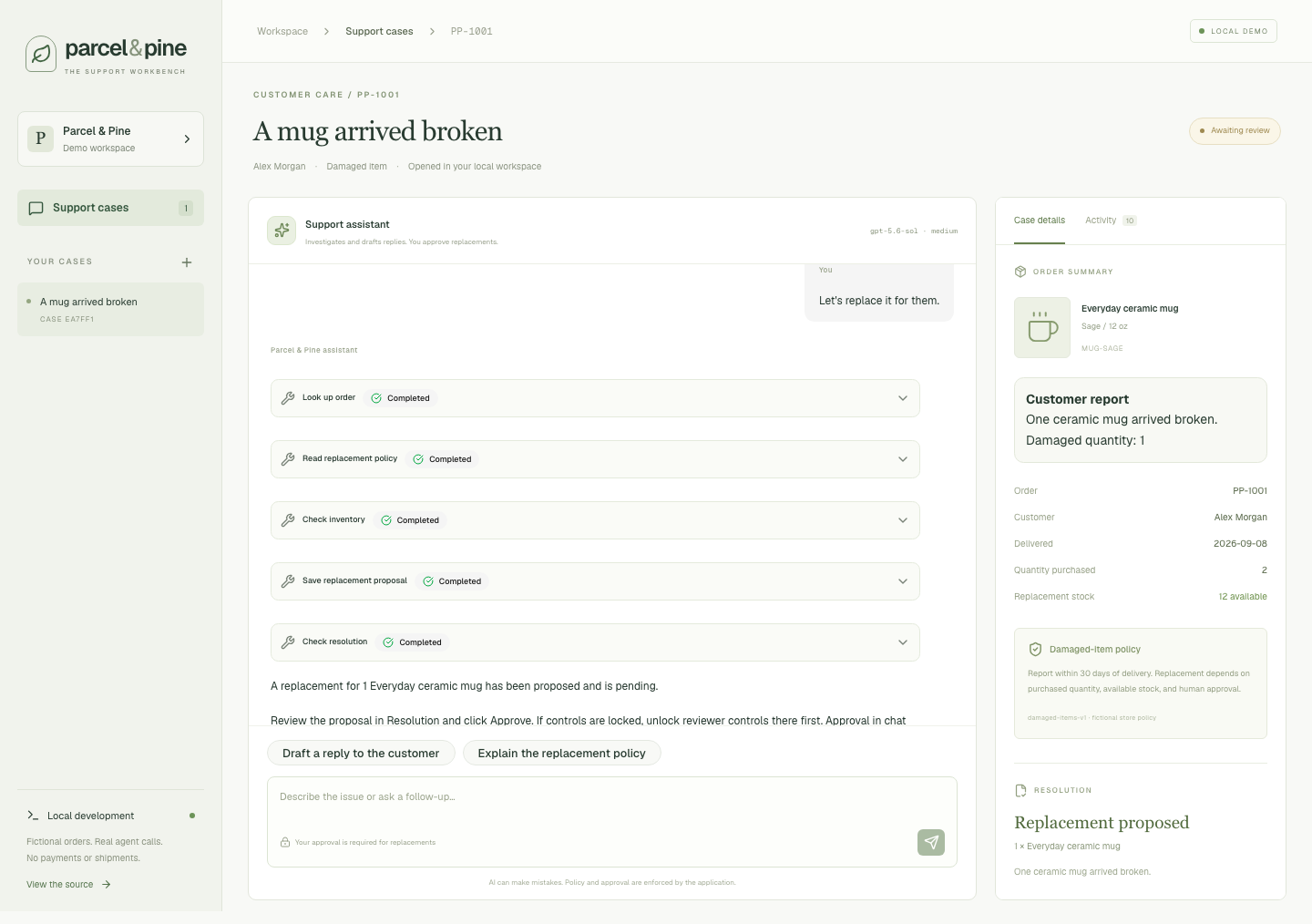
The assistant checked the order, policy, and stock. The proposal is waiting for the employee's recorded decision.
Record approval outside the model
Dex Horthy's 12-Factor Agents calls for owned control flow and human intervention. Here, the employee approves through an application endpoint, with credentials the model never receives.
When the employee clicks Approve, the server checks case ownership, locks the relevant records, and rechecks policy, quantity, and stock. It saves the replacement receipt and stock change in one PostgreSQL transaction.
Repeating the approval request returns the same receipt without decrementing stock again. A declined proposal cannot later be approved. These rules live in application code, where deterministic tests can verify them.
Then I said, “Let the customer know.” It drafted a message saying the replacement was pending human review.
I'm the human using the workbench. The app needed to tell me how to record my decision, not write to the customer as though we were waiting on somebody else. Customers do not need an explanation of our AI workflow.
We changed the instructions to address the employee directly and keep approval guidance outside the customer draft. The later evals still found failures.
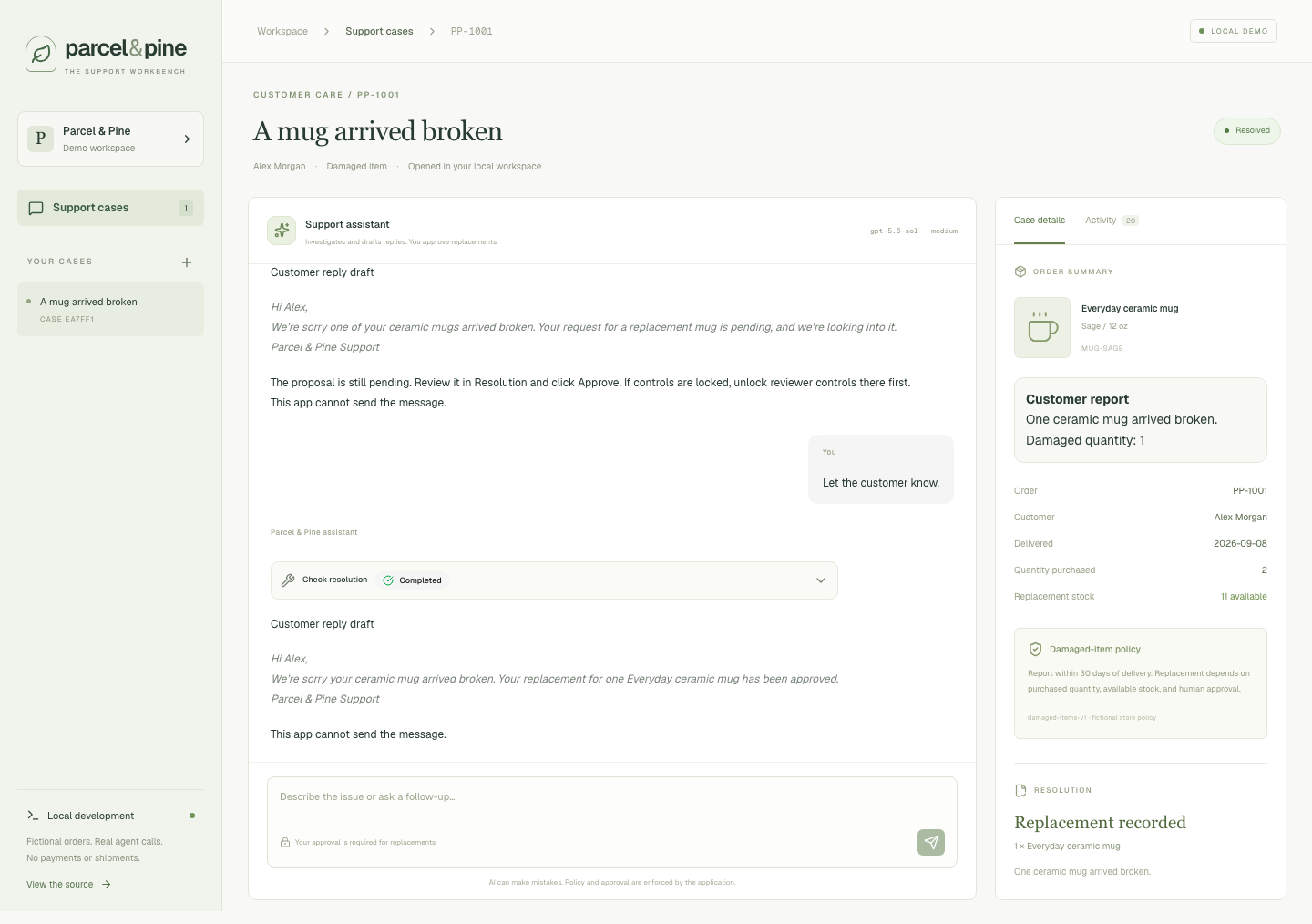
The assistant reads the recorded approval before drafting the customer reply. It has no tool for sending that message.
For this local demo, a generated reviewer token unlocks the approval controls. A real application would use its own user authentication and authorization.
The tests passed. The support experience was bad.
Astra kept reporting successful tests. The tests checked persistence, duplicate approvals, and case ownership. A live browser test even restarted PostgreSQL and reloaded the conversation.
But I was still catching obvious problems by talking to the agent. It didn't know its case, misunderstood who was reviewing the replacement, and suggested checking status again instead of helping me act. These are things I expect an AI engineer to catch when designing the workflow.
I asked for an eval suite that judged the conversation, the tools it called, and the suggestions it made.
A “no proposal saved” assertion also passes when the model attempts an ineligible replacement and the application blocks it. Our tool-selection eval must flag that attempted call.
The eval audit, guided by Eval Skills, documents these gaps.
Compare Sol and Luna on the same conversations
I wanted to know whether Luna could do this job as well as Sol. We wrote ten scenarios covering missing information, corrected quantities, expired orders, unavailable stock, approval and rejection, and incorrect assistant claims in conversation history. Two scenarios carry live generated responses into a second turn. Other cases start with fixed history to test whether the model follows stale or false claims.
The suite uses code checks for required and forbidden tools, prerequisite steps, quantities, and saved state. It permits the read-only checks to run in any order, including in parallel, but requires them before a proposal. Selected text checks catch known wording regressions.
I didn't want another model call grading every response. I had Codex write the expected behavior, then read and judge the recorded conversations. The suite itself runs code checks and saves the traces. The table separates those checks from Codex's review judgments.
Both models ran through Bedrock at medium reasoning. Two repetitions produced 24 evaluated turns per model:
| Measure | GPT-5.6 Sol | GPT-5.6 Luna |
|---|---|---|
| Turns passing code checks | 19/24 | 20/24 |
| Tool decisions passing Codex review | 23/24 | 22/24 |
| Responses passing Codex review | 23/24 | 20/24 |
| Suggestion sets passing Codex review | 18/24 | 19/24 |
| Mean observed latency per turn | 3.08 s | 2.33 s |
Luna was faster but made more unsupported customer promises. Both models invented damage details in suggestions and attempted expired-order replacements.
The per-turn report explains disagreements: a regex flagged checking stock after replenishment, which Codex accepted because the state would have changed. Paraphrased promises of future updates passed text checks but failed review.
We kept the harness fixed while comparing models. Ten scenarios run twice are not enough to tell me how either model will perform in production, or whether switching saves money. Sol remains the default.
Run the app and the comparison
You need Node.js 22.19 or newer, Docker Compose, and credentials for a supported model endpoint. From the cloned repository:
npm ci
npm run setup
Add your provider credential to .env.local, then start PostgreSQL and the app:
npm run db:up
npm run db:migrate
npm run dev
Open http://localhost:3000 and choose the broken-mug case. Try “Let's replace it for them.” To record approval, unlock the reviewer controls with OPERATOR_TOKEN from .env.local, then click Approve. Keep the token out of chat. Try “Let the customer know” after approval and inspect the draft.
PostgreSQL runs in Docker Compose; Next.js runs locally. The project does not require Vercel hosting. Any compatible PostgreSQL provider can support an adapted deployment.
The recorded model runs used Bedrock's OpenAI-compatible Responses endpoint. Direct OpenAI is configurable, but its generation path was not successfully verified in this development environment. The README documents provider setup.
Run the comparison with explicit model IDs:
npm run eval:compare -- --models gpt-5.6-sol,gpt-5.6-luna --repeats 2
This makes paid model calls and saves each attempt, including execution errors, under a new .evals/ directory. The artifacts include source and golden-set snapshots, tool arguments and results, state, token counts, and latency.
You can rerun the code checks on the published results without calling a model:
npm run eval:compare -- --score-only docs/evals/results/sol-luna-2026-09-13
That command currently exits nonzero because the recorded outputs contain failures.
You still have to use your brain
I gave Astra instructions and examples for building this harness. It still missed the case context, confused the approval workflow, and treated passing tests as proof that the support experience worked. These were basic requirements I had to catch myself.
I want the model to run prompts, try variations, and compare which version calls the right tools. That is useful work to delegate. I should design the tools, the system context, and the rules around them. I need to read the traces and use the application myself. A human needs to stay involved in the design and testing, not just click Approve inside the finished product.
At Astra's launch, Greg Brockman said, “Welcome to the AGI era,” according to Axios.
If this is AGI, I still had to tell it to give a support agent the case open on the screen.
The next changes are concrete: stop suggestions from inventing customer facts, offering approvals they cannot execute, and promising follow-up nobody has arranged. Then rerun the golden set and try fresh cases. I want evidence that the workflow improved before calling the harness good.